
Blog

Insights
The Trust Deficit: Why Your Leadership is Failing the Volatility Test

Steven Asnicar


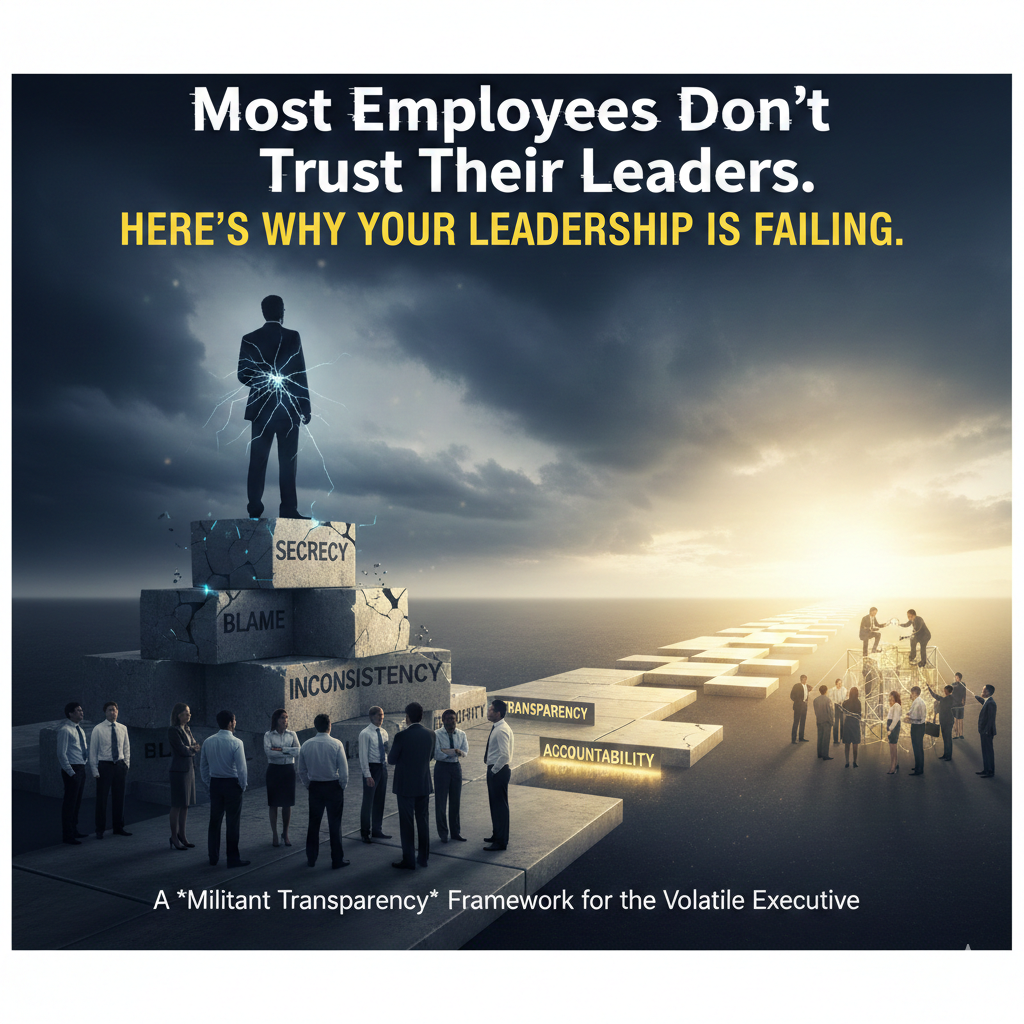
In an era of relentless disruption, organizational trust is no longer a soft skill …. it is a volatile currency. While leaders claim to prioritize culture, the data tells a different story: The majority of your workforce does not trust you. Research from Gartner indicates that fewer than half (48%) of employees have faith in senior leadership. This isn’t just a morale issue; it is a structural vulnerability that sabotages decision-making and leaves organizations brittle in the face of economic headwinds.
The High Cost of “Trust-Breaking” Behaviors
Many executives operate under the illusion of competence while actively eroding their own authority. When leaders prioritize optics over honesty, they trigger a cascade of disengagement. The following behaviors are not just “poor form” they are statistically proven to dismantle the foundation of the enterprise:
- Information Asymmetry: Concealing “the whole story” reduces trust by 20%. In the absence of data, employees fill the vacuum with fear and speculation.
- The Accountability Gap (Scapegoating): Shifting blame to external market forces or “uncontrollable factors” reduces trust by 30%. It signals to the workforce that leadership is powerless or dishonest.
- Strategic Inconsistency: Backtracking on decisions without rigorous justification reduces trust by 20%, painting leadership as reactive rather than visionary.
Beyond the Town Hall: A Mandate for Radical Accountability
Building trust in a “perma-crisis” environment requires more than an open-door policy. It requires a fundamental overhaul of the executive-employee contract. To bridge the 52% trust gap, leaders must move beyond platitudes and adopt a militant transparency framework.
- Weaponize Data to Expose Trust Deficits
Stop guessing how your employees feel. Trust must be audited with the same rigor as financial performance. Leaders must incorporate “Trust KPIs” into their annual assessments, specifically targeting the frequency of backtrack-events and perceived sincerity. If you are not transparently publishing your trust deficits and your plan to fix them, you are part of the problem.
- Radical Decision-Rationale (The 4.3x Multiplier)
The data is clear: employees are 4.3 times more likely to trust leaders who explain the “Why.” Transparency is not an admission of weakness; it is a strategic alignment tool. In the wake of painful restructures or layoffs, a leader’s primary job is to articulate the cold logic of the trade-offs made. If you cannot explain your criteria, your workforce will assume the worst.
- Authenticity as a Performance Metric
The 2025 Gartner State of Employee Experience Survey highlights a massive disconnect: employees care about compensation, flexibility, and growth, yet leaders often focus on “corporate mission” rhetoric. Trust increases 6.5 times when leaders address the granular, uncomfortable issues, pay and autonomy, head-on. Anything less is perceived as performative.
- Behavioural Re-Engineering
Trust is a skill, not a personality trait. Organizations must invest in intensive behavioural development that focuses on Emotional Intelligence (EQ) and Ethical Decision-Making. This is not about “softening” the leader, but about hardening their ability to lead through complexity without losing the mandate of the governed.
The Bottom Line is this.
Trust is the only lubricant for a high-velocity organization. Without it, every strategic pivot faces internal friction that costs time, money, and talent. Leaders who fail to address their trust deficits aren’t just losing hearts and minds they are losing their competitive edge.